
Aditya Cranes Pvt. Ltd.

Jib Crane Manufacturers

Jib Crane Manufacturers in India
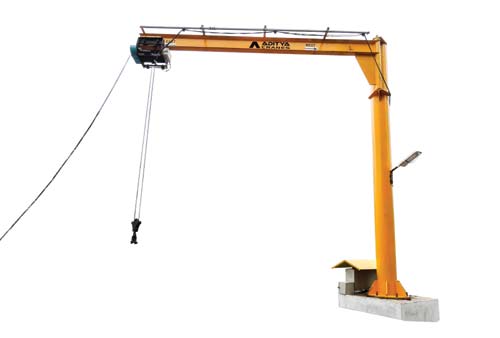
When heavy materials need to be lifted, positioned, and moved around a specific workstation, a conventional overhead crane is not always the most practical choice. This is where a Jib Crane becomes extremely useful. A jib crane provides localized lifting within a defined working area and can significantly reduce manual material handling, improve productivity, and make repetitive lifting operations safer and easier.
Aditya Cranes is an experienced Jib Crane Manufacturer in India, offering customized lifting solutions for engineering workshops, manufacturing plants, fabrication units, warehouses, automobile industries, power plants, and other industrial applications. The company’s jib crane solutions include Wall Mounted Jib Cranes, Column Mounted Jib Cranes, and Pillar Mounted (Free Standing) Jib Cranes, allowing customers to select a configuration according to their available space and lifting requirements.
Aditya Cranes’ wall or column-mounted jib cranes are designed for workstation applications and are available in capacities from 0.5 MT to 10 MT, with outreach of up to 10 metres according to the company’s published specifications. Its pillar-mounted free-standing models are designed for direct installation on the shop floor and are available in capacities from 0.5 MT to 5 MT, with outreach of up to 8 metres.

About Aditya Cranes

Aditya Cranes provides industrial lifting and material handling equipment designed around specific customer applications. Rather than treating every lifting requirement as identical, crane selection can be adapted according to parameters such as lifting capacity, outreach, hook height, slewing requirement, hoist type, operating speed, and control system.
This application-oriented approach is particularly important when selecting a jib crane. A crane installed beside a machining centre may have completely different requirements from one used for loading and unloading fabricated components. Similarly, a workstation requiring occasional manual lifting may not need the same configuration as a production station operating continuously throughout the day.
For this reason, selecting an experienced jib crane manufacturer is an important part of achieving reliable and economical material handling.

What Is a Jib Crane?

A jib crane is a type of lifting equipment consisting primarily of a vertical support structure and a horizontal or articulated jib arm. A hoisting unit travels along the jib, allowing loads to be lifted and positioned within the crane’s operating area.
Depending on the design, the jib can rotate manually or through a motorized slewing mechanism. The combination of lifting, trolley movement, and slewing allows an operator to move a load from one location to another without relying entirely on manual handling.
Think of a jib crane as a dedicated lifting assistant for a particular workstation. Instead of moving an entire overhead crane across a large factory, the jib crane brings the lifting capability directly to the location where it is needed.

Types of Jib Cranes Manufactured by Aditya Cranes

Wall Mounted and Column Mounted Jib Cranes

Wall Mounted Jib Cranes and Column Mounted Jib Cranes are particularly useful where an existing building column or suitable structural support is available. They are designed to provide localized lifting without requiring a separate floor-mounted crane foundation.
Aditya Cranes states that its wall or column-mounted jib cranes are suitable for workstation applications and can be mounted on steel building columns, while special designs can also be provided for installation on RCC columns. Published capacities range from 0.5 MT to 10 MT, with outreach of up to 10 metres.
The jib can use rolled beams, with over-braced construction used to achieve an efficient structural arrangement. For smaller capacities and outreaches, under-braced construction is also available. Articulated jib arms can be provided for specialized workshop requirements.

Pillar Mounted Free Standing Jib Cranes

A Pillar Mounted Jib Crane, also known as a Free Standing Jib Crane, is independently installed on the shop floor. It does not require an existing building column to support the crane.
This makes it particularly useful when a dedicated lifting station is required in an open area or when the existing building structure cannot support a wall-mounted jib crane.
According to Aditya Cranes’ published specifications, its pillar-mounted jib cranes are available from 0.5 MT to 5 MT capacity with outreach of up to 8 metres. The pillar is designed with sufficient strength, while the jib rotates on anti-friction bearings. Manual and motorized slewing options are available.

Jib Crane Specifications

The correct jib crane should be selected according to the actual lifting application rather than capacity alone. Important parameters include the maximum load, working radius, hook height, frequency of operation, lifting speed, slewing method, trolley movement, and available installation space.
Parameter
Typical Consideration
Crane Type
Wall Mounted / Column Mounted / Pillar Mounted
Lifting Capacity
Application dependent
Outreach
Based on required working radius
Slewing
Manual or Motorized
Hoisting
Manual Chain Hoist / Electric Chain Hoist / Wire Rope Hoist
Trolley
Push-Pull / Geared / Motorized
Control
Pendant / Radio Remote
Drive
Standard / VVVF
Installation
Building Column or Independent Foundation
Application
Workstations / Production / Maintenance / Material Handling
Aditya Cranes offers different combinations of hoisting and trolley arrangements so that the crane can be matched to the operational requirement.

Special Features of Aditya Cranes Jib Cranes

Manual and Motorized Slewing

One of the important advantages of Aditya Cranes’ jib crane range is the availability of manual as well as motorized slewing. Manual slewing can be appropriate for simpler workstation applications, while motorized slewing can make repetitive load positioning easier.
This flexibility allows customers to avoid unnecessary complexity in applications where it is not required while still having the option of powered movement when productivity demands it.

Multiple Hoisting Options

Different industries require different lifting arrangements. Aditya Cranes provides three broad hoisting configurations for its jib crane solutions :
This range allows the crane to be configured according to load, operating frequency, lifting height, and desired level of automation.

VVVF Drive for Smooth Operation

VVVF drive technology can be provided for hoisting, trolley travel, and slewing movements. Variable-frequency control allows smoother acceleration and deceleration, which can help reduce sudden movements during load handling.
For applications where accurate positioning matters, controlled movement can make a significant difference. It can also provide operators with better control when handling expensive machinery, components, moulds, dies, or fabricated assemblies.

Radio Remote Control

Radio remote control is available for remote operation of the crane. This can allow an operator to stand at a more suitable position while controlling crane movements, depending on the application and safety requirements.
Remote operation can be particularly useful when visibility, workstation layout, or load positioning makes pendant operation less convenient.

Robust Jib Construction

Aditya Cranes uses different structural arrangements according to capacity and outreach. Its wall/column-mounted jib cranes can use rolled beams with over-braced or under-braced construction, while articulated jib arrangements can be provided for specialized requirements.
The structural configuration is selected to provide an appropriate balance between strength, stiffness, operating area, and overall crane design.

Applications of Jib Cranes

A jib crane can be an excellent solution wherever materials need to be repeatedly lifted and transferred around a localized workstation. Common applications include :
For example, a manufacturing plant may use a jib crane to lift a heavy motor from a pallet, position it near an assembly area, and lower it accurately onto the workstation. The crane does not need to cover the entire factory; it simply performs the lifting job where it is installed.

Benefits of Using a Jib Crane

A properly selected jib crane can provide several practical advantages. The first is localized material handling. Instead of assigning workers to manually move heavy components, the crane performs the lifting and positioning work.
The second major benefit is improved workflow. When lifting equipment is available directly at the workstation, operators spend less time waiting for a shared overhead crane. This can reduce unnecessary material movement and improve production efficiency.
Jib cranes can also be economical because they are designed around a specific lifting zone. Depending on the configuration, they may require considerably less infrastructure than a complete overhead crane system.
For businesses expanding production or upgrading individual workstations, this makes jib cranes a practical way to introduce mechanical lifting without redesigning the entire facility.

Wall Mounted vs Pillar Mounted Jib Crane

Feature
Wall/Column Mounted
Pillar Mounted
Building Support
Required
Not required
Foundation
Uses structural support
Dedicated floor foundation
Installation
Building column/wall
Independent pillar
Space Requirement
Efficient where columns exist
Requires floor space for pillar
Typical Application
Workstations near columns
Independent workstations
Slewing
Manual/Motorized
Manual/Motorized
Hoist Options
Multiple options
Multiple options
The choice between the two depends primarily on the building structure and workstation layout. If a suitable structural column is already available, a wall or column-mounted crane can be an efficient option. If the lifting station needs to be independent, a pillar-mounted jib crane can provide greater installation flexibility.

Why Choose Aditya Cranes as a Jib Crane Manufacturer?

Choosing a crane manufacturer should involve more than comparing the initial equipment price. The crane needs to match the application, structural conditions, operating cycle, and safety requirements.
Aditya Cranes provides multiple jib crane configurations and hoisting arrangements, allowing customers to develop a solution around their actual material handling process. Its published product information also highlights options including VVVF drives, motorized slewing, radio remote control, and multiple trolley configurations.
This flexibility is valuable for industries that need a jib crane not simply to lift a load, but to become an integrated part of the production workflow.

How to Select the Right Jib Crane

Before purchasing a jib crane, businesses should evaluate several factors. The first is the maximum load, including the heaviest item that will ever be lifted. Selecting capacity based only on the average load can create problems when an unusually heavy component needs to be handled.
The second factor is outreach. The boom must reach every required pickup and drop-off point without creating unnecessary structural loading. Hook height, available headroom, floor conditions, and the location of nearby equipment should also be considered.
The operating frequency is equally important. Occasional lifting may be suitable for a simpler configuration, whereas repetitive production operations may benefit from an electric hoist, motorized trolley, motorized slewing, and VVVF control.
A professional crane manufacturer can evaluate these parameters and recommend an appropriate configuration rather than simply supplying a standard model.

Maintenance of Jib Cranes

Regular inspection and preventive maintenance are essential for safe crane operation. Operators should routinely check the hook, chain or wire rope, brakes, electrical controls, trolley mechanism, slewing components, and structural connections.
For pillar-mounted cranes, the foundation, anchor bolts, base plate, and pillar should also be inspected periodically. Any unusual noise, vibration, movement, or visible structural damage should be investigated before continued operation.
Maintenance requirements vary according to crane design and operating conditions, so the manufacturer’s recommended inspection and servicing schedule should always be followed.

Frequently Asked Questions

A jib crane is primarily used for localized lifting and material handling around a workstation. It is commonly used for machine loading, assembly, fabrication, maintenance, and component handling.

Aditya Cranes manufactures Wall Mounted, Column Mounted, and Pillar Mounted (Free Standing) Jib Cranes, with configurations customized according to application requirements.

Published specifications indicate capacities from 0.5 MT to 10 MT for wall/column-mounted jib cranes and 0.5 MT to 5 MT for pillar-mounted jib cranes.

Yes. Aditya Cranes provides both manual and motorized slewing options depending on the crane configuration and application.

Yes. Radio remote control is available as an option for applicable jib crane configurations, providing greater flexibility for crane operation.